
MDS Computational Linguistics
UBC’s Master of Data Science (MDS) in Computational Linguistics is the credential to set you apart. By the end of the intensive program, students have developed a deep familiarity with large language models (LLMs) — how they are trained, what we understand about their internals, what is needed to get from a base language model to the agents that can automate industrial workflows. The program trains students in the fundamentals as well as the frontier of language AI technology, preparing them for a job market where understanding large language models inside-out is a highly desirable skill.
MDS Computational Linguistics is a 10-month program offered at the Vancouver campus, taught by research faculty who are researching cutting-edge questions around language models and AI concurrently to teaching MDS students. The first semester of MDS Computational Linguistics is mostly shared with MDS Vancouver, building fundamentals of programming and thinking about data, and the second semester focuses specifically on language AI, with courses on LLM engineering fundamentals, interpretability, agent engineering, and evolving current topics.
For information on the MDS Computational Linguistics program, please go here.
Program Benefits
Highlights Across All MDS Programs:
- 10-month, full-time, accelerated program offers a short-term commitment for long-term gain
- Condensed one-credit courses allow for in-depth focus on a limited set of topics at one time
- Capstone project gives students an opportunity to apply their skills
- Real-world data sets are integrated in all courses to provide practical experience across a range of domains
Highlights Specific To Computational Linguistics:
- Students learn how to use and build AI models including Large Language Models (LLMs), chatbots, Retrieval Augmented Generation (RAG) systems, and agentic workflows
- Students combine the fundamental data science skills, techniques, and tools learned with the core Master of Data Science cohort, with then branching off into specialized courses on language technology
- MDS Computational Linguistics specific courses are taught by research faculty working on the frontier of LLM research, and include research seminar-style classes where we read the latest developments in AI.
- Courses are taught by a combination of linguistics, computer science, and statistics faculty members giving students access to experts within each field of study.
- UBC’s Vancouver campus offers students the unrivaled experience of a top 40 university, surrounded by remarkable natural beauty, all in a cosmopolitan city
- Strong connections with industry partners in public and private sectors, start-ups, and leading tech companies offer a wide range of networking/career opportunities.
Upcoming Event
Why the L Matters - LLMs, AI, and MDS Computational Linguistics
The MDS Computational Linguistics program at UBC is an accelerated Master’s that provides a strong foundation in data analytics, while also allowing for a concentration in AI engineering and language processing. Learn why humanity’s oldest invention - language - is essential for the understanding of its newest and most state-of-the-art technologies.
Are you passionate about language?

Are you passionate about language and curious about data? UBC’s Master of Data Science in Computational Linguistics specialization was designed for you. An accelerated, 10-month, full-time program gets you into a career faster.

MDS Computational Linguistics Frequently Asked Questions - Admissions
In this video, Garrett Nicolai, Director and Assistant Professor of Teaching, for the UBC Master of Data Science (MDS) Computational Linguistics program, answers the most frequently asked question about the admissions process for the MDS Computational Linguistics program.

MDS Computational Linguistics Frequently Asked Questions - Program
In this video, Garrett Nicolai, Director and Assistant Professor of Teaching, for the UBC Master of Data Science (MDS) Computational Linguistics program, answers the most frequently asked question about the MDS Computational Linguistics program.
Curriculum*
The program structure includes 24 one-credit courses offered in four-week segments. Courses are lab-oriented and delivered in-person.
At the end of the six segments, an eight-week, six-credit capstone project is also included, allowing students to apply their newly acquired knowledge, while working alongside other students with real-life data sets. Please note that instructors are subject to change.
* subject to change at the discretion of the MDS Computational Linguistics program
Fall: September - December
Block 1 (4 weeks, 4 credits)
Programming for Data Science | DSCI 511
Program design and data manipulation with Python. Overview of data structures, iteration, flow control, and program design relevant to data exploration and analysis. When and how to exploit pre-existing libraries.
Shareable Course Page
Muhammad Abdul-Mageed
Computing Platforms for Data Science | DSCI 521
How to install, maintain, and use the data scientific software stack. The Unix shell, version control, and problem solving strategies. Literate programming documents.
Shareable Course Page
Ilya Musabirov (Section 1), Daniel Chen (Section 2)
Programming for Data Manipulation | DSCI 523
Program design and data manipulation with R. Organizing, filtering, sorting, grouping, reformatting, converting, and cleaning data to prepare it for further analysis.
Shareable Course Page
Gittu George (Section 1), Payman Nickchi (Section 2)
Descriptive Statistics and Probability for Data Science | DSCI 551
Fundamental concepts in probability including conditional, joint, and marginal distributions. Statistical view of data coming from a probability distribution.
Shareable Course Page
Payman Nickchi (Section 1), Alexi Rodriguez-Arelis (Section 2)
Block 2 (4 weeks, 4 credits)
Algorithms & Data Structures | DSCI 512
How to choose and use appropriate algorithms and data structures to help solve data science problems. Key concepts such as recursion and algorithmic complexity (e.g., efficiency, scalability).
Shareable Course Page
Muhammad Abdul-Mageed
Data Visualization I | DSCI 531
Exploratory data analysis. Design of effective static visualizations. Plotting tools in R and Python.
Shareable Course Page
Joel Östblom (Section 1 and 2)
Statistical Inference and Computation I | DSCI 552
The statistical and probabilistic foundations of inference. Large sample results. The frequentist paradigm.
Shareable Course Page
Alexi Rodriguez-Arelis (Section 1), Rodolfo Lourenzutti (Section 2)
Supervised Learning I | DSCI 571
Introduction to supervised machine learning. Basic machine learning concepts such as generalization error and overfitting. Various approaches such as K-NN, decision trees, linear classifiers.
Shareable Course Page
Varada Kolhatka (Section 1 and 2)
Block 3 (4 weeks, 4 credits)
Corpus Linguistics | COLX 521
Why do modern language models operate on tokens instead of words? What’s the difference? How do we transform large data corpora into mathematical representations that can be processed by modern AI? This course introduces the concept of textual transformation that allows modern AI to function properly.
Shareable Course Page
Garrett Nicolai
Databases & Data Retrieval | DSCI 513
How to work with data stored in relational database systems. Storage structures and schemas, data relationships, and ways to query and aggregate such data.
Shareable Course Page
Gittu George (Section 1 and 2)
Regression I | DSCI 561
Linear models for a quantitative response variable, with multiple categorical and/or quantitative predictors. Matrix formulation of linear regression. Model assessment and prediction.
Shareable Course Page
Rodolfo Lourenzutti (Section 1), Payman Nickchi (Section 2)
Feature and Model Selection | DSCI 573
How to evaluate and select features and models. Cross-validation, ROC curves, feature engineering, and regularization.
Shareable Course Page
Prajeet Bajpai (Section 1), Elham E Khoda (Section 2)
Winter: January - April
Block 4 (4 weeks, 4 credits)
Parsing for Computational Linguistics | COLX 535
Learn the linguistic theory behind grammatical structure - the techniques that make large language models possible. This course introduces students to the analysis of linguistic output, interpreting the grammatical structure for deeper meaning that can help identify shortcomings in AI output.
Shareable Course Page
Garrett Nicolai
Computational Semantics | COLX 561
An introduction to Large language models (LLMs). How do we get AI models that can understand and produce human language? This course introduces the idea of creating semantic vector spaces through language generation, as well as the architectures used in LLMs.
Shareable Course Page
Isabel Papadimitriou
Unsupervised Learning | DSCI 563
How can we learn the answers to problems that don’t have labels? This course introduces students to a sequence of unsupervised methods for clustering, dimensionality reduction and vector visualization, and teaches students to find structure in messy data.
Shareable Course Page
Garrett Nicolai
Supervised Learning II | DSCI 572
How do modern neural networks learn? This course introduces the mathematical foundations of deep learning and optimization, Topics include optimization methods from gradient descent to Adam and Muon optimizers, architectures ranging from fully connected networks to transformers, and various methods for language modeling, with a focus on mathematical derivation and code implementation.
Shareable Course Page
Jian Zhu
Block 5 (4 weeks + 1 week break, 4 credits)
Advanced Corpus Linguistics | COLX 523
We have the data, so what can we do with it? From annotation to deployment, this course introduces students to data stewardship and ownership. Students create and deploy a corpus and dashboard that is informative and accessible, all while taking ownership through an AGILE framework.
Shareable Course Page
Garrett Nicolai
Computational Morphology | COLX 525
What happens when the word is not small enough, and our systems need to pick them apart further? Learn how linguistics has defined “meaning bearing units”, and how we adapt that knowledge to gain insight about how to interpret the output of AI in several modalities: text and speech.
Shareable Course Page
Garrett Nicolai
Machine Translation | COLX 531
How are large language models actually built and deployed? This course covers the major stages of modern LLM engineering, including how to scale up in pre-training, how methods like RLHF and RLVR are used in post-training, and how to design LLM inference engines for real-world deployment.
Shareable Course Page
Jian Zhu
Sentiment Analysis | COLX 565
A research seminar-style class, reading recent papers in the field and discussing their implications. Main focuses are interpretability (methods for understanding what’s happening in the black box of LLMs) and the effects of LLMs on human psychology and society.
Shareable Course Page
Isabel Papadimitriou
Block 6 (4 weeks, 4 credits)
Advanced Computational Semantics | COLX 563
Topics in LLMs. This course connects the fundamentals learned in COLX 561 and DSCI 531 to some of the concerns of building and using LLMs today. Topics include scaling laws, GPUs, embedding models, and architectural choices.
Shareable Course Page
Isabel Papadimitriou
Natural Language Processing for Low-Resource Languages | COLX 581
We’re in the Big Data revolution, but not all languages have equal amounts of data. Learn how to adapt large language models to smaller data, including efficient methods of selecting from limited examples, bootstrapping and ensembling, LoRA and PEFT, and in context and few-shot learning.
Shareable Course Page
Garrett Nicolai
Trends in Computational Linguistics | COLX 585
The latest developments in NLP and AI. Topics change each year to follow major new directions in the field. This iteration focuses on recent innovations in neural architectures, LLM agents, reasoning and tool use, and multimodal understanding and generation.
Shareable Course Page
Jian Zhu
Privacy, Ethics & Security | DSCI 541
How do we establish fairness while also preserving security? What is AI doing with your data, and how should we approach questions concerning digital colonialism?
Shareable Course Page
Garrett Nicolai
Spring: May - June
Capstone Project (8-10 Weeks, 6 credits)
Capstone Project | COLX 595
A mentored group project based on real data and questions from a partner within or outside the university. Students will formulate questions and design and execute a suitable analysis plan. The group will work collaboratively to produce a project report, presentation, and possibly other products, such as a web application.
Shareable Course Page
MDS Computational Linguistics Staff
Meet Amy
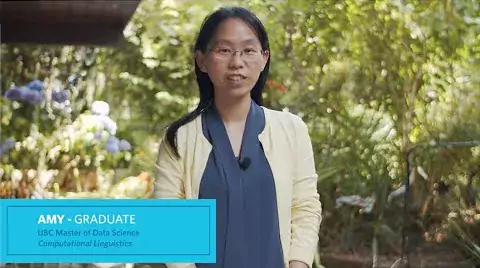
Even though Amy found the MDS Computational Linguistics program an intensive and accelerated one, it actually better fit her needs. Amy felt the most important thing they learned is to solve problems and once you are able to see a clear picture of the data, you are able to feel a sense of achievement.